
October 16, 2025
As the global art market shifts, new categories are rising while others reset—creating rare moments of opportunity. From cultural momentum to market data, discover insider perspectives on the best art to invest in 2025—and why these art investment opportunities are defining the moment for discerning collectors.
The Best Art to Invest In 2025: Discover The 5 Top Art Investment Opportunities Right Now
Forget the market hype and headline-grabbing auctions—2025 is gearing up to be a year driven by substance over speculation. Across the art world, shifts in geography, buyer demographics and institutional influence are rewriting the rules of what constitutes a smart acquisition.
For investors seeking the best artists to invest in—or contemplating diversification across the top alternative investment classes—the focus is turning to categories with proven liquidity, cultural momentum and long-term growth. From the ascent of young female artists to renewed confidence in blue-chip names, these are the art investment opportunities capturing collectors’ attention in 2025.
1. Power Shift: Why Collectors Are Backing Young Female Artists
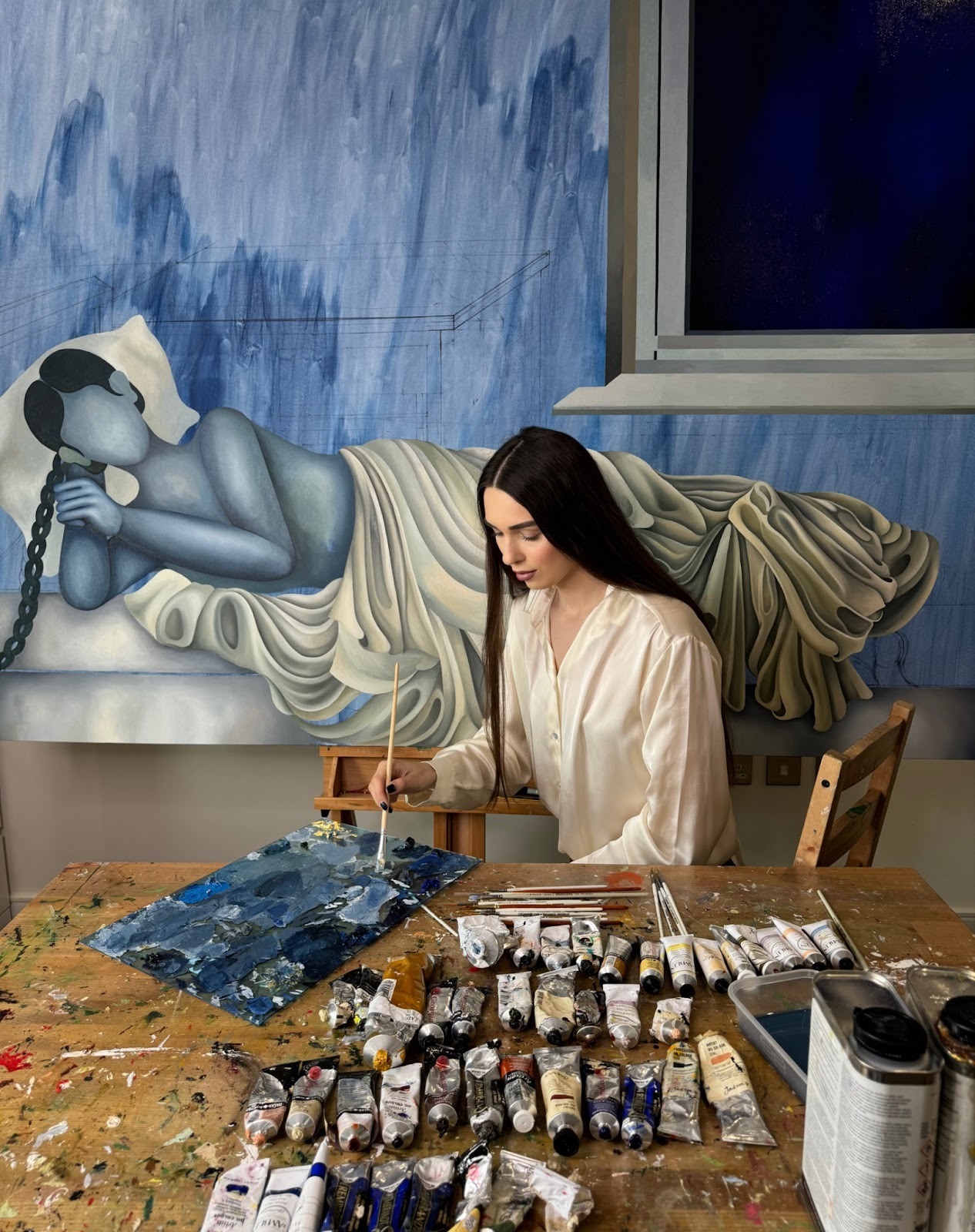
Artist Celine Ali in her London studio
Over the past decade, the conversation around women in modern art has evolved from long overdue recognition to meaningful change. Collectors are no longer simply discovering young female artists—they’re actively competing for their work. Museums are broadening their collections, galleries are expanding representation, and investors are beginning to see what the data confirms: these rising talents have turned a once-overlooked category into a cornerstone of Contemporary art investment.
Between 2018 and 2024, global sales of art by women rose from $523.7 million to $675.6 million and nearly doubled its market share from 6.2% to 13.8%. In the same period, male artists saw annual sales fall by 10%. Nowhere is this growth stronger than in the young Contemporary and Contemporary female artists categories.
|
Art Market Insight: Women Artists on the Rise As institutional endorsement and collector demand align, women artists are emerging as one of the most resilient and liquid segments in today’s contemporary art market. Key Highlights:
|
By 2024, 1,148 women were represented at major auctions, a 132% increase since 2018, with 82% of those artists under the age of 45. Their art is performing too: from 2021 to mid-2025, works by women delivered 7.6% compound annual growth, with average prices up 20.6% year-on-year.
Up-and-coming female artists like Celine Ali, Charlotte Rose and Helen Beard are emblematic of this new generation. Ali, already achieving six-figure results, benefits from robust institutional support, while museums such as Tate and MoMA report that women now account for 40–54% of solo exhibitions and acquisitions. This conviction is strengthening across the board: in 2025, 78% of women’s lots at auction carried guarantees—an agreement that ensures a seller will receive a minimum sale price for their work—up from just 30% in 2018.
For prospective buyers seeking the top artists to invest in 2025, the combination of growth, liquidity and curatorial validation makes Contemporary female artists one of the most dynamic corners of the art sector today.

Number of Women Artists and Market Share (2018-2025) © Sotheby's Insight Report “Women Artists”, June 2025
2. New Frontiers: How Emerging Art Markets in India, the UAE and Singapore Are Redefining the Art Map
Once considered peripheral to the global art scene, regions like the UAE, India and Singapore are now driving its next chapter. Across these emerging art markets, rising private wealth and ambitious cultural programmes are transforming local ecosystems into international investment hubs. At the same time, investors across these regions are helping to build new cultural centres that unite creativity, ambition and high-value art investment opportunities.
India’s rise is particularly striking. The 2024 India Art Fair hosted 109 exhibitors and 72 galleries, with VIP attendance up 30% on opening day. The artist Raghav Babbar epitomises this new energy: at just 27, he’s quickly become one of the best emerging artists to invest in. His painting The Coal Seller achieved £609,600 at auction in 2023, against a high estimate of £30,000. Since 2022, he has maintained a 100% sell-through rate and generated £2.4 million in turnover. With international exposure from Art Basel Hong Kong to ICA Miami, his trajectory reflects the growing reach of the India art market.
Behind this lies a broader economic and cultural surge. India is home to more than 868,000 millionaires, while Saudi Arabia, Singapore and the UAE collectively add nearly one million more. Supported by national initiatives, from Riyadh’s Vision 2030 to the Sharjah Biennial, these regions are investing in culture as infrastructure, laying fertile ground for collectors and investors alike. Offering both cultural and financial upside, these regions open new horizons for portfolio diversification and a chance to discover new artists to invest in with the potential to become tomorrow’s blue-chip names.
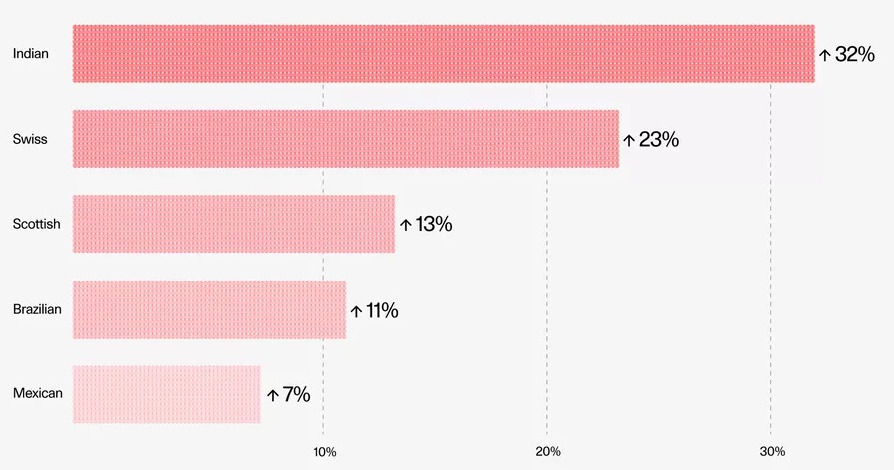
Year-on-Year Inquiry Growth by Nationality (2024) © Artsy
3. Complete Prints Portfolios: When the Sum Becomes More Valuable Than the Parts
Prints have long been a cornerstone of the art landscape, offering accessibility, liquidity and cultural cachet. But within this category, one segment consistently stands out: complete portfolios. Sets by artists such as Andy Warhol, Keith Haring, Damien Hirst and KAWS command notable premiums, often outperforming single prints sold individually. Why? Because portfolios unite stability with story, making them among the best art to invest in for those seeking to own an artist’s vision in its entirety.
Even in a cautious 2024, Warhol’s portfolios proved resilient. ‘Endangered Species’ (1983) achieved a record £3.4 million—a 22% rise year-on-year—while his ‘Marilyn’ (1967) portfolio climbed 24% to £2.9 million. What keeps investors returning to these sets is their rarity and completeness—they represent a narrative, told in full.
Portfolios also provide diversification within a single acquisition and frequently prove more resilient in resale. In a market where individual prints already perform strongly, complete portfolios offer a sense of cohesion that deepens their artistic and investment value.

Damien Hirst, Love Poems (2013)
4. Undervalued Blue-Chip Artists: Why a Market Reset Can Signal Opportunity
In every cycle of the art market, periods of recalibration create new openings. After the speculative highs of 2021-22, valuations for major blue-chip artists, particularly in the street art segment, have settled, opening the door for strategic investors to re-enter at more sustainable levels. For those seeking the best art to invest in 2025, this recalibration represents a rare moment of balance, where strong fundamentals align with more attainable entry points.
Few artists illustrate this more clearly than Banksy. Both a cultural phenomenon and one of the art world’s most consistent performers, his works are currently trading around 30-40% below their 2021 peaks, yet recent figures show a steady rebound. Over the past year, prices have climbed 16.4%, and 2024 print sales have already surpassed those of 2023.
|
Art Investment Tip: Watch for Undervalued Icons - The Case for Banksy After a period of market correction, Banksy’s works are trading around 30-40% below their 2021 highs, presenting a chance to enter a globally recognised market with strong fundamentals and proven resilience. Market signals to watch:
|
Banksy’s influence extends far beyond the gallery walls. With a 25-year career marked by landmark projects such as ‘Dismaland’ (which drew 150,000 visitors) and ‘Cut & Run’ (180,000 visitors), plus a following of more than 13 million on Instagram, Banksy remains one of the most recognisable names in Contemporary art. His collectors are equally diverse, from Angelina Jolie to Damien Hirst and Stormzy, and authentication through Pest Control continues to underpin trust and liquidity in his marketplace. Looking ahead, the forthcoming Banksy catalogue raisonné, expected in late 2025, will offer formal validation for around 30,000 works, a move likely to further stabilise and strengthen his standing.
If you are weighing whether to buy Banksy art or re-engage with his work, this moment in time offers a rare opening. Global demand is holding firm, secondary sales are regaining momentum, and his authentication process continues to set the benchmark for transparency. Following recent price corrections, those conditions make him one of the best blue-chip artists to invest in for 2025 and an appealing choice for those looking to buy a Banksy with long-term growth potential.

Market Cap © Live Art
5. Legacy in Motion: Why Late-Career Blue-Chip Artists Are Gaining Ground
With blue-chip art investment, timing is everything, and the later, more uncertain stages of an artist’s life often mark a key inflection point for value. Figures such as Yayoi Kusama, David Hockney, Bridget Riley and Tracey Emin are cultural icons and renowned blue-chip artists who have entered a delicate and fascinating phase of their careers, where artistic legacy meets the reality of finite supply.
Research shows that prices for established artists typically rise an average of 6% in the five years before their death, as collectors anticipate the end of production. What happens next depends largely on estate management. Values often dip briefly in the year of death (by around 26% on average), before stabilising and climbing again once estates tighten supply and museums mount retrospectives.
|
Collector Insight: Blue-Chip Legacy Effect – How prices shift before and after an artist’s passing End-of-career dynamics play a decisive role in blue-chip art values, where timing and estate management can be just as influential as name recognition. Markets reward those who recognise when legacy becomes scarcity. Market patterns to note:
|
The recent passing of Mel Bochner, a pioneer of conceptual and language-based art, is a case in point. His bold textual works, including the ‘Amazing’ series, are held in major institutions from MoMA and Tate Modern to the Centre Pompidou and the Whitney. In 2024, even before his death, 88% of his auctioned works sold within or above estimate. With his oeuvre now finite, that interest is only set to intensify.
Those exploring the top artworks to invest in 2025 should take note of these mature segments, which offer a measured, strategic advantage—a chance to back artists whose reputations are already secure, but whose markets may still have room to grow as their legacies continue to crystallise.
Conclusion: The Art Market Is Not One-Size-Fits-All
The five categories above represent some of the most compelling art to invest in 2025, from the rise of upcoming female artists and emerging markets to the resilience of blue-chip names and the ongoing appeal of complete portfolios. The art world rarely moves as one—success depends on discernment and recognising nuance rather than chasing trends. Ultimately, the most rewarding collections are built where data, culture and intuition converge, guided by the same instinct that has always driven great collectors: to seek out artists worth investing in whose work carries lasting significance.
Contact Maddox Art Investment Advisory to begin your collecting journey.
The value of investments can go down as well as up, and past performance is not guarantee of future performance. Return figures shown are gross; fees, including a 20% performance commission, may apply. Liquidity is not guaranteed. Terms, limitations, and withdrawal conditions apply. Minimum recommended investment is £20,000. Maddox Advisory is not FCA-regulated and does not give financial advice. Seek independent advice before investing.
READ MORE


Previous
Next
Basket
Please note items are not reserved until you have completed checkout.
No items found
Close
Your saved list
This list allows you to enquire about a group of works.
No items found
Enter your email to subscribe to our weekly newsletter.
Speak to a Maddox Art Advisor
Please enter your details below and someone from Maddox Gallery will call or email you back.
Mikael B
Register your interest in
Mikael B
Ross Muir
Register your interest in
Ross Muir
Andy Gotts
Register your interest in
Andy Gotts
Seb Chaumeton
Register your interest in
Seb Chaumeton
Miaz Brothers
Register your interest in
Miaz Brothers
The Connor Brothers
Register your interest in
The Connor Brothers
Jerkface
Register your interest in Jerkface.

Register your interest in

London
Gstaad
Los Angeles


